
Employment Contracts for Japan Work Visas
Drafting Employment Contracts for Japan Work Visas: Key Points for Employers
When hiring foreign professionals in Japan under work-related statuses of residence such as
“Engineer/Specialist in Humanities/International Services” or the
Highly Skilled Professional (HSP) visa, the employment contract itself will be closely reviewed by the Immigration Services Agency.
Immigration officers will examine whether:
- the foreign employee is treated on conditions equivalent to or better than Japanese employees, and
- the terms of employment comply with Japanese labor laws, including the Labor Standards Act.
A contract that is incomplete, internally inconsistent, or misaligned with the intended visa status can become a ground for questions, delays, or even denial of the work visa.
This article outlines the core clauses and unique issues you should address when drafting an employment agreement for a foreign national in Japan.
1. Essential Clauses Required Under Japanese Labor Law
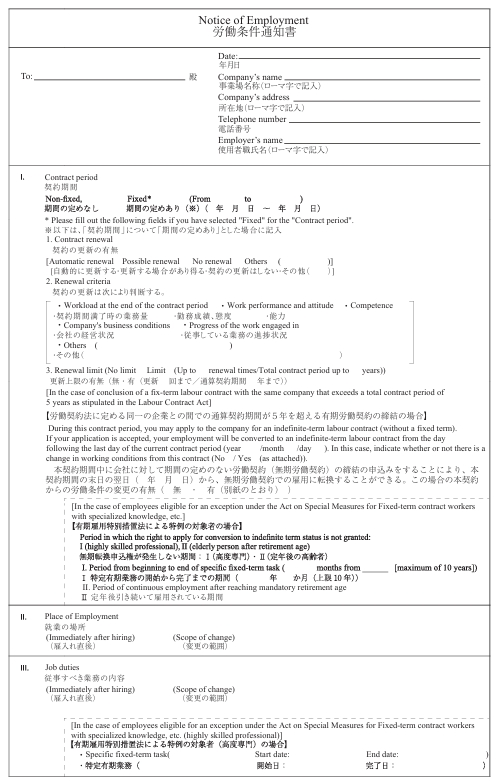
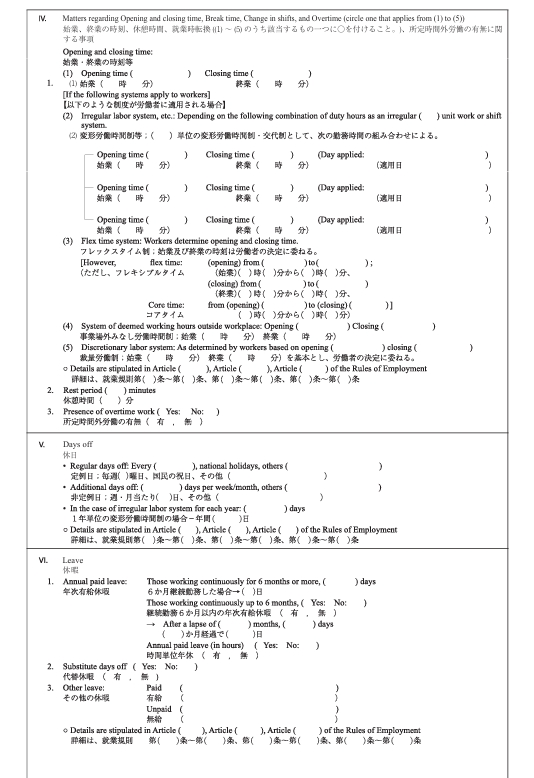
Under Japanese labor law, certain working conditions must be clearly provided in writing, typically through an employment contract or a written notice of working conditions.
The following items should, at a minimum, be drafted with care.
Specific content should be finalized in consultation with a Japanese labor and social security attorney (sharoushi) or other qualified professional.
- Term of the employment contract
For fixed-term contracts, clearly state:- the start and end dates,
- whether renewal is possible,
- objective criteria for renewal or non-renewal, and
- any upper limit on the total number of renewals or maximum years of employment.
- Place of work and job title / duties
Specify the primary place of employment (and any possible alternative locations if relevant) and describe the position and core responsibilities in sufficient detail. - Working hours, breaks, days off, and leave
Clearly set out:- starting and ending times of the workday,
- break times,
- weekly days off and public holidays, and
- paid annual leave and other statutory or company-specific leave.
- Compensation structure and payment method
Describe how the employee’s pay is determined and calculated (e.g., monthly salary, overtime premiums, allowances), and state the payment method (bank transfer, etc.). - Payroll cut-off date and payment date
Indicate the closing date for salary calculation (for example, the 20th or end of month) and the regular payday. - Salary increase (base-up and merit increases)
Note whether salary increases are available, and if so, on what basis (e.g., company performance, individual evaluation, years of service). - Termination of employment and dismissal
Provide clear rules regarding resignation by the employee and dismissal by the employer, including:- grounds for dismissal,
- notice periods, and
- any applicable severance or retirement benefits.
- Overtime work beyond prescribed working hours
Include whether overtime is expected, and, if so, ensure that overtime work is covered by a valid labor-management agreement and that overtime premiums will be paid in accordance with Japanese law. - Right to request conversion from fixed-term to indefinite-term employment
Where applicable, explain under what conditions (e.g., more than five years of continuous fixed-term contracts) the employee may request conversion to an indefinite-term contract and how such requests are handled. - Special items for part-time or fixed-term employees
In the case of part-time workers or fixed-term employees, clearly indicate:- whether they are eligible for salary increases,
- whether they receive retirement allowances,
- whether bonuses are paid, and
- the contact point for consultation regarding improvement of employment management and working conditions.
2. Special Considerations When Employing Foreign Nationals
2.1 Remuneration Level: Equal or Better Than Japanese Employees
For most work-related statuses of residence in Japan, including the
Engineer/Specialist in Humanities/International Services visa and the
Highly Skilled Professional visa, immigration authorities will verify that the foreign employee’s
overall remuneration is at least equivalent to that of Japanese employees in comparable positions.
When assessing this requirement, immigration officers generally look at the following:
- Included in “remuneration”:
Basic salary, performance-based bonuses, qualification allowances, position allowances, and other taxable cash payments that form part of the regular compensation package. - Not usually counted as “remuneration”:
Commuting allowances (transportation reimbursement) and company-paid costs for leased corporate housing are typically treated as expense reimbursements or fringe benefits and may not be fully recognized as salary for visa screening purposes. - Market-consistent and lawful pay:
The salary level should be in line with industry standards and must not fall below the applicable regional minimum wage.
If the salary is significantly lower than that of Japanese employees in similar roles, the work visa application may be questioned.
From a practical standpoint, many practitioners consider a full-time monthly salary of
around JPY 200,000 or more as a baseline for ordinary white-collar roles, though the appropriate level depends on the employee’s seniority, industry, and location.
2.2 Job Description Must Match the Status of Residence
A foreign national’s permissible job duties in Japan are strictly defined by the category of their
status of residence.
If the job description in the employment contract exceeds the scope of the intended visa, the application may be denied.
For example:
- Under the Engineer/Specialist in Humanities/International Services visa, the employee is expected to engage in work that requires specialized knowledge or skills, such as IT engineering, finance, marketing, or professional translation.
- The same employee generally cannot be assigned primarily to manual labor or simple repetitive tasks, such as factory line work, basic cleaning, food preparation in a kitchen, or heavy physical construction work.
- Unlike many Japanese employees in a so-called “generalist” track, foreign employees with a work visa are not allowed to perform “any and all tasks” within the company indiscriminately. Their duties must be consistent with the visa category described in the immigration application.
Therefore, the job description section of the employment contract should:
- clearly describe professional, specialized, or international duties, and
- avoid vague wording that could be interpreted as authorizing simple labor or broad, unrestricted work.
2.3 Condition Precedent: “Subject to Visa Approval” Clause
In employment contracts with foreign nationals, it is common practice in Japan to include a
condition precedent tied to immigration approval.
This is often drafted so that the contract becomes effective only if and when the foreign employee is granted the appropriate status of residence.
A typical formulation in English might read as follows:
“This Employment Agreement shall become effective on the date on which the Employee is duly granted and maintains a status of residence in Japan that lawfully permits full-time employment with the Employer. If such status of residence is not granted, or is denied by the Japanese immigration authorities, this Agreement shall be null and void, and neither party shall owe any further obligations hereunder, except as otherwise expressly provided.”
This type of clause helps to:
- make clear to the immigration authorities that the employment relationship is contingent on legal eligibility to work, and
- manage the risk that the visa application is refused, in which case the employment will not commence.
Because the enforceability and impact of such clauses may vary depending on the full contract and surrounding circumstances, they should be drafted in consultation with Japanese labor-law and immigration-law professionals.
3. Practical Drafting Tips for HR and In-House Counsel
- Align Japanese and English versions
If you prepare both Japanese and English texts, state which version is legally controlling and ensure there are no material inconsistencies between the two.
Immigration officers will typically rely on the Japanese version where available. - Specify work locations realistically
If relocation or assignment to different offices within Japan is possible, indicate that clearly while maintaining consistency with the immigration application (for example, by designating a primary site and listing possible secondary locations). - Confirm social insurance and labor insurance coverage
Note that the employee will be enrolled in the appropriate social insurance schemes (health insurance, pension, employment insurance, etc.) in accordance with Japanese law.
Immigration authorities frequently review social insurance status when assessing ongoing renewals. - Address side jobs and concurrent employment
Clarify whether the employee is permitted to engage in secondary employment or freelance work.
Even when the contract allows side jobs, the employee may need separate permission from immigration if the additional work falls outside the scope of the main visa. - Manage fixed-term contracts carefully
Where a fixed-term employment contract is used, keep in mind the legal rules on repeated renewals and the employee’s right to request conversion to an indefinite-term contract after long-term continuous service. - Ensure internal policies are consistent
Work rules, employee handbooks, and internal policies should not contradict the employment contract.
Inconsistencies can raise red flags both in labor disputes and during immigration review.
4. Seek Professional Advice Early
When hiring a foreign employee in Japan, it is not sufficient to simply reuse the same employment contract template used for Japanese employees.
In addition to ordinary labor-law considerations, you must take into account:
- the requirement to provide conditions equal to or better than those of Japanese employees,
- whether the job duties are strictly within the scope of the intended status of residence, and
- whether a visa-related condition precedent and other protective clauses are appropriately drafted.
Because immigration law and labor law intersect in complex ways, employers are strongly encouraged to consult both:
- a social insurance and labor consultant or other labor-law specialist for compliance with Japanese labor regulations, and
- a Japanese immigration lawyer or administrative scrivener experienced in work visa applications to confirm that the contract supports a successful visa filing.
Careful drafting at the outset will not only reduce the risk of visa denial but also help prevent future disputes, protecting both the foreign employee and the employer.
About the Author
 Masakazu Murai
CFP, Chartered Member of the Securities Analysts Association of Japan, Gyoseishoshi (Immigration Lawyer)
Born in 1977, Mr. Murai previously worked in the Investment Banking Division of Mitsubishi UFJ Morgan
Stanley Securities, advising listed companies on equity and debt offerings as well as M&A transactions.
While in investment banking, he also served on the central executive committee of the employees’ union,
promoting diversity in the workplace and better working conditions for foreign professionals and women.
Today he focuses on Japanese immigration procedures for foreign nationals – particularly
spouse visas and permanent residence – together with personal and corporate finance consulting.
His practice frequently combines residence strategy with long-term financial and life-planning considerations.
Takes only 3 minutes. Start your consultation
For Foreign Nationals Considering Japan
- Working in Japan or transferring with your employer
- Establishing a business in Japan
- Marrying a Japanese national and obtaining a spouse visa
- Applying for permanent residence
- Exploring naturalization (Japanese citizenship)

We share practice-oriented immigration updates, case examples and commentary that do not
always appear on the main website through our LINE@ account. Add us as a friend to receive the latest
information directly on your phone. You are also welcome to use LINE to start a consultation or request
representation.