
HSP Type 2 Japan | Expert Guide
HSP Type 2 or Permanent Residency in Japan? A Strategic Immigration Guide for Global Professionals
How Foreign Executives, Entrepreneurs and Highly Skilled Professionals Can Choose the Right Long-Term Residence Status
Japan Immigration Insights | October 2026
For internationally mobile professionals, choosing a Japanese residence status involves more than meeting immigration requirements. The decision can influence career mobility, business ownership, family arrangements and retirement planning.
Many foreign executives and specialists regard Japanese permanent residency as the natural next step after establishing a successful career in Japan.
Yet permanent residence is not the only immigration status that permits an indefinite stay.
Japan’s Highly Skilled Professional (ii) status, or HSP Type 2, offers an indefinite period of stay, extensive professional privileges and special immigration arrangements for qualifying family members.
The important question is not simply which status offers more benefits. It is which status best accommodates your future professional and personal circumstances.
The Key Distinction: Professional Privileges vs. Long-Term Independence
Both HSP Type 2 and Permanent Resident status permit foreign nationals to remain in Japan without a fixed expiration date for their period of stay.
However, their underlying legal structures are different.
HSP Type 2 is an employment-related residence status designed for individuals who continue contributing to Japan through qualifying advanced professional activities.
Permanent Resident status, by contrast, is not tied to a particular occupation or professional activity.
This distinction becomes particularly important when an individual changes employers, establishes a company, sells a business or decides to retire.
In short: HSP Type 2 offers valuable professional and family-related privileges, while permanent residency generally provides greater independence from employment and career circumstances.
Neither status should be treated as automatically superior.
When HSP Type 2 May Be the Better Choice
Consider an international executive who plans to continue managing a Japanese subsidiary while raising young children in Tokyo.
The executive may value the ability to arrange qualifying parental support from overseas, employ a foreign domestic worker under applicable conditions, and undertake multiple professional activities.
For this individual, HSP Type 2 can offer practical advantages unavailable solely through Permanent Resident status.
The same reasoning may apply to researchers, senior technology specialists, investment banking professionals and entrepreneurs expecting to remain professionally active in Japan.
HSP Type 2 provides:
- An indefinite period of stay without ordinary extension procedures.
- Permission to undertake a broad range of professional activities alongside qualifying highly skilled work.
- Preferential employment arrangements for eligible spouses.
- Special arrangements for parents assisting with childcare or pregnancy-related needs.
- Opportunities to employ foreign domestic workers, subject to immigration requirements.
The qualification to remember is that the HSP holder must continue performing activities recognized under the Highly Skilled Professional framework.
How to Qualify for HSP Type 2
The ordinary pathway is intended for foreign nationals with an established history of highly skilled professional activities in Japan.
Applicants generally need at least three years of qualifying activities under HSP Type 1 or a recognized predecessor Highly Skilled Professional category.
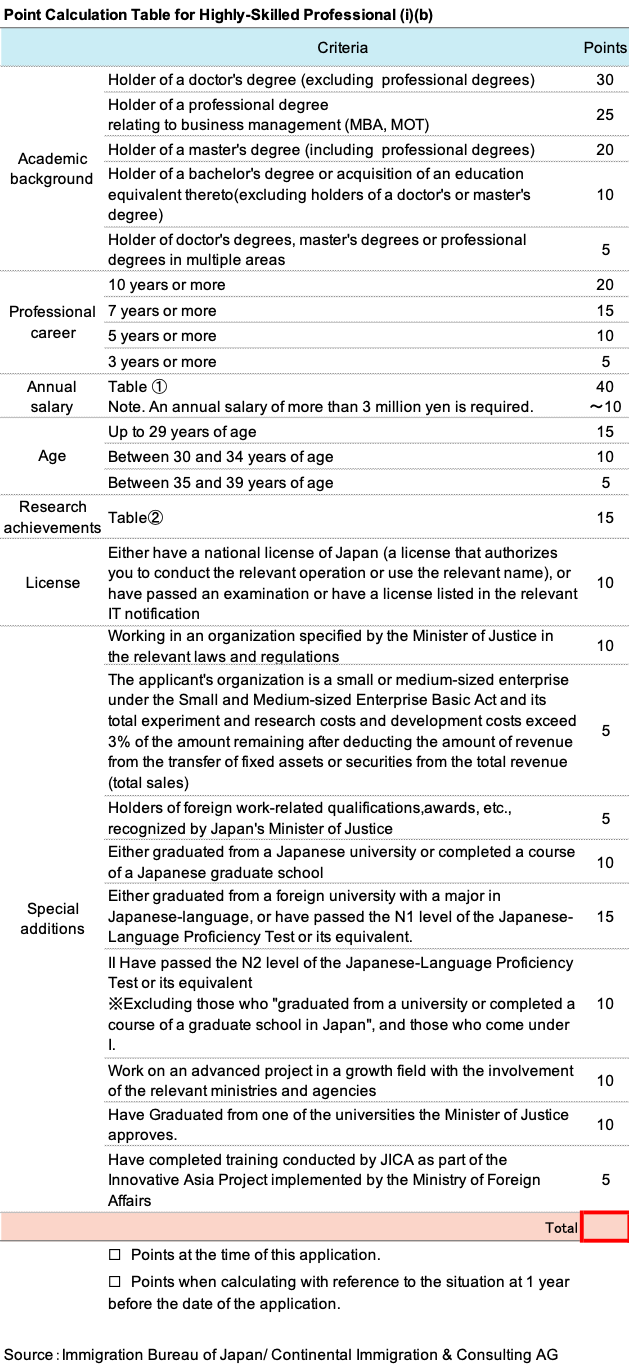
They must also demonstrate at least 70 points under the applicable points system when applying for HSP Type 2.
The examination additionally considers good conduct, compliance with immigration requirements, Japan’s national interests, and whether the proposed activities fall within the authorized HSP framework.
Consequently, completing three years in Japan does not independently establish eligibility.
For example, an applicant who has worked in Japan for several years under an ordinary employment status should not assume that employment history alone satisfies the specific activity-history requirement for HSP Type 2.
A detailed examination of previous residence statuses and authorized professional activities is necessary.
J-Skip: A One-Year Route for Certain Senior Professionals
Japan also operates the Special Highly Skilled Professional system, commonly called J-Skip.
This framework recognizes individuals meeting particularly demanding educational, professional experience and remuneration criteria.
Eligible J-Skip professionals may become qualified to move to HSP Type 2 after one year of qualifying activities.
| Professional Category | Principal Eligibility Criteria |
|---|---|
| Advanced Academic Research / Advanced Specialized or Technical Activities | Master’s degree or higher, or at least 10 years of relevant professional experience, plus annual remuneration of at least JPY 20 million |
| Advanced Business Management Activities | At least 5 years of management experience and annual remuneration of at least JPY 40 million |
For certain senior executives, financial professionals and highly experienced specialists, J-Skip may provide a comparatively efficient route to an indefinite period of stay.
However, applicants must demonstrate that they satisfy the applicable J-Skip criteria and other immigration requirements.
An Important Consideration for Executives: What Happens After a Business Sale?
Business ownership and executive responsibility can change substantially over time.
A foreign entrepreneur may initially establish a company in Japan, develop the business over several years and eventually sell a controlling interest to another investor.
Similarly, a foreign executive may resign from a multinational corporation following a merger, restructuring or acquisition.
These situations can create immigration consequences for HSP Type 2 holders.
Under Japan’s immigration framework, failing to engage continuously in qualifying HSP activities for six months may constitute grounds for revocation, unless a justifiable reason exists.
Therefore, selling a company or leaving an executive position does not necessarily cause an immediate loss of residence status, but a prolonged cessation of qualifying activities can create significant risks.
A business owner planning an exit should consider immigration status before completing the transaction, rather than after stepping down from management.
For professionals intending to retire, take an extended career break or live in Japan without employment, Permanent Resident status will generally provide greater flexibility.
A Side-by-Side Comparison of Immigration Freedom
The following table summarizes the principal differences relevant to career planning and family life.
| Comparison | Highly Skilled Professional (ii) | Permanent Resident |
|---|---|---|
| Period of stay | Indefinite | Indefinite |
| Extension of period of stay | Not required | Not required |
| Employment activities | Broad, but qualifying HSP activities must continue | Generally unrestricted |
| Retirement or extended unemployment | Status may be revoked following six months without qualifying activities, unless justified | Retirement alone does not constitute grounds for revocation |
| Changing employers / starting a business | Subject to applicable activity and notification requirements | Generally unrestricted |
| Bringing parents to Japan | Special arrangements under specified conditions | No general sponsorship entitlement based solely on PR |
| Employing foreign domestic workers | Special arrangements available | No HSP-specific immigration privilege |
| Spouse’s employment | Preferential arrangements for specified professional activities | A spouse holding Spouse of Permanent Resident status may work without occupational restrictions |
| Revocation of residence status | Nonperformance of qualifying HSP activities may constitute grounds for revocation | Limited to applicable statutory grounds |
An indefinite period of stay does not mean that either status is immune from revocation. Both remain subject to Japanese immigration law.
Furthermore, foreign residents holding either status must maintain valid residence cards and comply with other applicable administrative obligations.
Three Career Scenarios That May Influence Your Decision
Scenario A: An Investment Banking Director Planning a Long-Term Career
An investment banking professional based in Tokyo expects to remain employed in financial services for the foreseeable future.
The individual may undertake regional management responsibilities, advise on cross-border transactions or move between financial institutions.
HSP Type 2 may be attractive because it permits an indefinite stay and offers a broad scope of qualifying employment activities.
Nevertheless, changes in employment and professional activities should be assessed for continued compliance with HSP requirements.
If the individual anticipates early retirement or an extended period outside professional employment, permanent residency may provide a more suitable long-term solution.
Scenario B: A Foreign Entrepreneur Preparing for an Exit
An entrepreneur has established a Japanese company and intends to sell it once the business reaches a certain valuation.
During the company’s growth phase, HSP Type 2 may offer valuable residence and family-related benefits.
After the sale, however, the entrepreneur may no longer undertake qualifying management activities.
Permanent residency may therefore become a strategically important consideration before the planned transaction.
Immigration planning should be coordinated with the entrepreneur’s expected management responsibilities and business exit timetable.
Scenario C: A Multinational Executive With Young Children
A senior corporate executive expects to continue working in Japan and requires additional family support.
Where the relevant conditions are met, HSP Type 2 may permit a parent to reside in Japan for qualifying childcare assistance.
The ability to employ a foreign domestic worker under specified arrangements may also be valuable.
For this household, the distinctive family-related privileges of HSP Type 2 could be more useful in the immediate future than the additional occupational freedom associated with permanent residency.
These scenarios illustrate why immigration decisions should be based on individual circumstances rather than a general ranking of residence statuses.
How the 2026 Permanent Residence Reform Changes the Calculation
Japan’s October 1, 2026 revision of the Guidelines for Permission for Permanent Residence introduces more detailed considerations concerning financial stability, retirement income, legal compliance and social integration.
Among the important developments is the assessment of whether an applicant’s household income consistently reaches a benchmark above the average income of Japanese households of comparable size.
Projected pension benefits and qualifying financial assets also play a greater role in evaluating long-term financial independence.
Japanese language proficiency, generally referenced to B1-level ability, is another consideration, although specified exceptions apply, including for qualifying highly skilled professionals and certain family members.
The revised framework will apply principally to applications filed from April 1, 2027, with some financial assessment provisions applicable to earlier applications.
These changes may make the choice between HSP Type 2 and permanent residency more consequential.
HSP Type 2 is governed by its own eligibility framework. It is not simply permanent residence under another name.
At the same time, foreign professionals who qualify for accelerated permanent residence should consider whether a direct PR application better serves their longer-term objectives.
Accelerated Permanent Residence for Highly Skilled Professionals
The Japanese government continues to provide shortened residence-history requirements for applicants who satisfy the Highly Skilled Professional points framework or J-Skip criteria.
| Highly Skilled Professional Classification | Qualifying Residence Period for PR Application |
|---|---|
| 70 points or more | Generally 3 years |
| 80 points or more | Generally 1 year |
| J-Skip eligible professionals | Generally 1 year |
These periods concern eligibility to apply, not guaranteed approval.
Other applicable legal requirements and the Minister of Justice’s comprehensive assessment remain relevant.
Crucially, applicants do not necessarily need to obtain HSP Type 2 before applying for permanent residency.
Individuals holding other qualifying residence statuses may benefit from the shortened residence-history rules if they can establish the required points and qualifying history.
This distinction can create an important planning opportunity for professionals who are already eligible for permanent residence.
Can You Move From HSP Type 2 to Permanent Residency Later?
Yes. HSP Type 2 and permanent residency can form part of a sequential immigration strategy.
An individual may initially obtain HSP Type 2 to benefit from its indefinite period of stay and special family-related arrangements while continuing professional activities.
Permanent residence may subsequently become more attractive as the individual’s circumstances change.
For example, an executive approaching retirement may prefer the greater freedom associated with Permanent Resident status.
Similarly, an entrepreneur considering a business sale may seek to separate long-term residence rights from continued company management.
However, permanent residence is not automatically granted because an individual holds HSP Type 2.
Applicants must independently satisfy the relevant permanent residence requirements and undergo examination.
Frequently Asked Questions
Is HSP Type 2 the same as permanent residency?
No. Both provide an indefinite period of stay, but HSP Type 2 remains associated with qualifying highly skilled professional activities. Permanent Resident status generally does not impose employment-activity restrictions.
Does HSP Type 2 require 70 or 80 points?
The ordinary HSP Type 2 pathway generally requires at least 70 points. The 80-point threshold is particularly relevant to the accelerated one-year permanent residence pathway.
Can an HSP Type 2 holder operate multiple businesses?
HSP Type 2 permits a broad range of professional activities, including qualifying business management activities. However, the actual activities must remain consistent with the applicable immigration framework.
What happens if I resign from my job?
Resignation does not automatically terminate HSP Type 2 status. Nevertheless, an extended period without qualifying activities may create grounds for revocation. The circumstances of the resignation and subsequent activities require consideration.
Is permanent residency always better for retirement?
Permanent Resident status generally provides greater flexibility because retirement alone does not require a change in residence status. However, it remains subject to applicable immigration laws and revocation provisions.
Continental Immigration: Immigration Planning for International Professionals
Continental Immigration Administrative Scrivener Corporation provides immigration services for highly skilled foreign professionals, international entrepreneurs, corporate executives and employees of multinational businesses.
Our practice includes applications involving HSP Type 1, HSP Type 2, J-Skip, Business Manager, Intra-company Transferee and Permanent Resident status.
We have supported professionals working in international finance, technology, consulting and other globally connected industries, as well as foreign entrepreneurs establishing and managing businesses in Japan.
For these applicants, immigration documentation frequently involves more than demonstrating an employment contract or academic qualification.
It may require a careful assessment of international career histories, compensation arrangements, executive authority, corporate structures, business ownership and planned professional activities.
Our experience in immigration administration and international finance enables us to approach these matters with an understanding of their broader commercial context.
Whether HSP Type 2 or permanent residency is more appropriate depends on where your career and personal circumstances are heading—not simply on your current points score.
We assist clients in evaluating eligibility, preparing application documentation and developing immigration strategies suited to their long-term plans in Japan.
Continental Immigration Administrative Scrivener Corporation
Highly Skilled Professional Visas | Executive Immigration | Permanent Residency
https://en.continental-immigration.com/
About the Author
 Masakazu Murai
Administrative Scrivener | Japanese Immigration and Highly Skilled Professional Specialist
Masakazu Murai is an administrative scrivener specializing in Japanese immigration procedures for highly skilled professionals, international executives and entrepreneurs.
Before entering immigration practice, he spent approximately 18 years in investment banking at Mitsubishi UFJ Morgan Stanley Securities, working in capital markets, corporate finance and mergers and acquisitions.
His financial background informs his immigration practice, particularly in matters involving executive responsibilities, international business operations, remuneration structures and entrepreneurial activities.
He holds the Certified Financial Planner (CFP) designation and is a Chartered Member of the Securities Analysts Association of Japan (CMA).
Legal information current as of October 2026. Immigration eligibility and outcomes depend on individual circumstances, applicable law and administrative practice.